Earl Spencer reveals he’d initially planned a ‘very different’ eulogy for his sister Princess Diana – and why he felt a ‘duty’ to change it

Earl Spencer has revealed that the eulogy he first drafted for Princess Diana‘s funeral was ‘very different’ to the speech he delivered at Westminster Abbey in which he made a number of swipes at the Royal Family.
Charles, 61, the younger brother of the late princess, said his original tribute to Diana, who died in a car crash in Paris on August 31, 1997, at the age of 36, was ‘a very traditional eulogy’ – which he quickly realised rang hollow.
While his first version detailed his sister’s achievements, it didn’t leave a lasting impression of ‘who she was’, Earl Spencer told Gyles Brandreth on the Rosebud podcast.
The morning after writing his first draft, he realised that rather than speaking about his sister, he would need to give her a voice.
He explained: ‘On the Tuesday night, I jotted a few things down, [a] very traditional eulogy, almost, you know, “She was very good at this as a child” and all that, and then I thought, “Well, this is ridiculous, that’s not who she was”.
‘And then overnight, I must have been chuntering away and I realised that my job, actually, wasn’t to do that but it was almost to speak for her.’
Charles continued: ‘And I knew I’d been left at that stage – it had no legal standing – but I knew she’d left me as guardian of her sons,’ referring to his nephews Prince William and Prince Harry, who were 15 and 12, respectively, when their mother died.
‘Obviously, the other parent being alive, that meant nothing, but it meant something to me,’ he added. ‘That sort of duty, I think. And then I wrote it in an hour and a half and, yeah, that was it, really.’

Charles Spencer and his older sister, Princess Diana, pictured in November 1985
Described by host Gyles as ‘the famous tribute’, Charles’s speech on Saturday, September 6, 1997, remembered Diana as ‘the very essence of compassion, of duty, of style, of beauty.’
Addressing his late sister in his eulogy, he said: ‘…on behalf of your mother and sisters, I pledge that we, your blood family, will do all we can to continue the imaginative way in which you were steering these two exceptional young men so that their souls are not simply immersed by duty and tradition but can sing openly as you planned.
‘We fully respect the heritage into which they have both been born and will always respect and encourage them in their royal role but we, like you, recognise the need for them to experience as many different aspects of life as possible to arm them spiritually and emotionally for the years ahead.
‘I know you would have expected nothing less from us.’
The late Queen and other senior royals refused to applaud after the Earl delivered his speech, even though Diana’s sons, William and Harry, did.
In the 2017 ITV documentary, Diana: The Day Britain Cried, which revealed for the the first time the inside story behind the day the royal was laid to rest, one of Her late Majesty’s most senior courtiers opened up about the thinly-veiled attack made by her brother on the Royal Family.
One member of the congregation also described the ‘peculiar and unusual’ moment the applause and cheers that greeted his controversial eulogy outside Westminster Abbey rippled through the congregation, which had been listening in stunned silence.
It is not clear whether the princess’s sons, who were 15 and 12 when she died and clearly beset by grief, understood the full extent of what their uncle was saying.

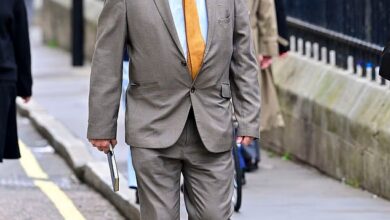
Charles (pictured) revealed that he scrapped his original eulogy for Princess Diana on the Rosebud podcast with Gyles Brandreth
But the awkwardness of the moment was encapsulated by Martin Neary, the Abbey’s musical director, who said: ‘I felt a great sympathy for what she had suffered but at the same time I was shocked by some of things which were said.
‘The princes actually applauded at the end, although the senior members of the Royal Family did not.’
Sir Malcom Ross, one of the late Queen’s right-hand men who was responsible for the funeral arrangement, added: ‘It grated to me on the day because I thought he was actually having a little bit of a go at the Royal Family.
‘It was my mistake to leave the doors of the Abbey open. What that meant was that when Lord Spencer made his remarks the audience outside applauded, which, in fact, started the audience inside applauding.’
He added, rather unconvincingly: ‘Fine. I don’t think anybody took offence.’
Elsewhere, in the same Rosebud episode, Charles also opened up about how he becomes ‘fundamentally unhappy’ on the anniversary of Diana’s death every year.
He politely explained that the unhappiness is exacerbated by strangers’ insistence on telling him where they were when his sister died.
Charles said: ‘I tell you what I do find quite difficult… it probably sounds ungracious but occasionally total strangers come up and feel they must tell me where they were when they heard she died.
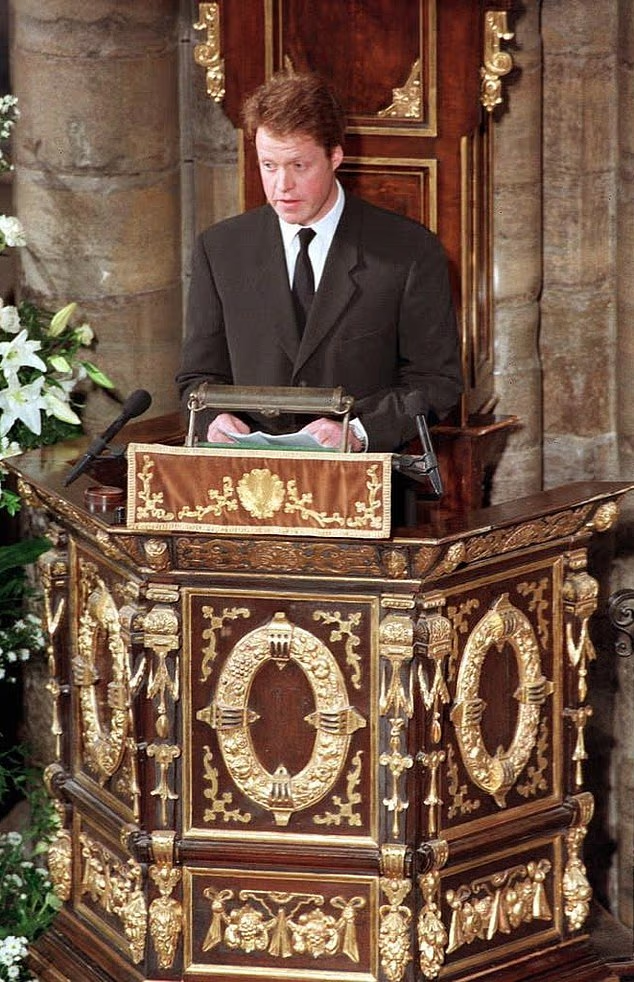
Described by host Gyles as ‘the famous tribute’, Charles’s speech on Saturday, September 6, 1997, remembered Diana as ‘the very essence of compassion, of duty, of style, of beauty.’ Pictured, the Earl making his address
‘I’m sure that’s helpful to them, it’s not entirely helpful to everyone else.’
He gave an example of an American woman who had told him that she grew up with Diana in South Dakota.
Charles recalled that the woman had ‘clutched me to her ample bosom and said that I may have thought I grew up with Diana, but actually she did in South Dakota’. He added: ‘You just have to smile, it doesn’t matter.’
Charles equally told how he and his seven children took flowers to Diana’s grave at the family’s Althorp estate, where she grew up, to mark the anniversary of her death.
‘I try and be really busy on August 31 because it’s just terribly sad, really,’ he told Gyles.
Reflecting on Diana’s ‘extraordinary’ legacy, he explained that he understood how much his sister still means to people.
‘It’s different things to different people, particularly to women of a similar age,’ he said. ‘They really invested their lives in hers.
‘Maybe they had an unhappy marriage, maybe they battled an eating disorder. There’s plenty of Diana to look into and take your bit out of – almost like a horoscope, you can make it make sense for you.’